
Who this is
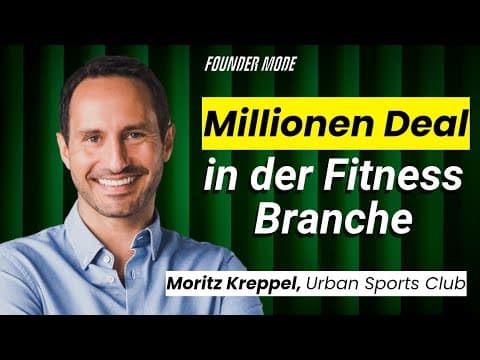
Moritz Kreppel was working as a consultant when he and his co-founder Benjamin set out to solve their own problem: gym, football, yoga and swimming on a single membership. In 2012 they started at a flex desk in Berlin's Betahaus, bootstrapped for almost two years and went live in January 2013 with 25 studios in Berlin. Today Urban Sports Club has more than 1,400 partner studios in Berlin alone, a strong corporate business, and it has acquired MyClubs. At the time of recording the merger with Wellhub had been signed but not yet closed; Moritz and Benjamin are keeping their shares and staying on in operational roles.
Episodes
Numbers from the episode
FAQ
How did Urban Sports Club start?
Moritz Kreppel and Benjamin started in 2012 at a flex desk in Berlin's Betahaus and bootstrapped for almost two years. They had the tech built cheaply in India and there was no app: members checked in with a plastic card they had to pick up at the office. Urban Sports Club launched in January 2013 with 25 studios in Berlin. To the episode →
How did Urban Sports Club get through the Covid lockdowns?
The funding round was signed at the notary on the Friday before the first lockdown. After that, Urban Sports Club offered livestreams from its partner studios within two days, let members pause by the day and passed 80 percent of fees on to the studios. Employees got short-time work and virtual shares. According to Moritz, what helped most were the corporate clients who stayed on. To the episode →
Why does Urban Sports Club focus on corporate clients?
According to Moritz, customer lifetime value is higher on the B2B side, and corporate contracts also reach people who haven't done sport before. Employers use the benefit mainly to be attractive in the war for talent and for their employees' health. Smaller companies subsidise each employee who signs up, larger ones agree a fixed sum covering everyone. To the episode →
Why is Urban Sports Club merging with Wellhub?
Moritz has known the Wellhub team for about ten years and sees a cultural fit. Corporate wellbeing is growing strongly and more and more corporate clients operate in several countries. With Wellhub, Urban Sports Club can offer corporate fitness in England, the US or South America too. Moritz clearly calls it an exit and a sale, but he and Benjamin are keeping their shares. At the time of recording the deal had been signed but not yet closed. To the episode →
Which fitness trends does Moritz Kreppel see?
Moritz names community as a big theme, visible for example at Hyrox, along with corporate wellbeing and holistic wellbeing including mental health apps. Recovery offerings such as ice baths are growing too, as are padel, bouldering, reformer pilates, free-weight areas in gyms and staff-free gyms. In Germany, he thinks boutique concepts at a more affordable premium-eco level work particularly well. To the episode →
Quotes
„Man musste uns ein Foto von der zerschnittenen Karte schicken. Also wirklich, das war MVP.““You had to send us a photo of the cut-up card. That really was an MVP.”
„Der Deal selbst, das ist natürlich auch Arbeit, aber die richtige Arbeit fängt danach erst an.““The deal itself is work too, of course, but the real work only starts afterwards.”
„Das war ein Moment, wo es wirklich wieder zurückgeht zu Co-Founder.““That was a moment when it really went back to being a co-founder.”
„Es ist schon ein Exit, muss man sagen. Es ist ein Verkauf.““It is an exit, you have to say. It's a sale.”
„Das kann ich explizit ausschließen, werden wir auf jeden Fall nicht machen.““I can explicitly rule that out, we're definitely not going to do it.”