

Who this is

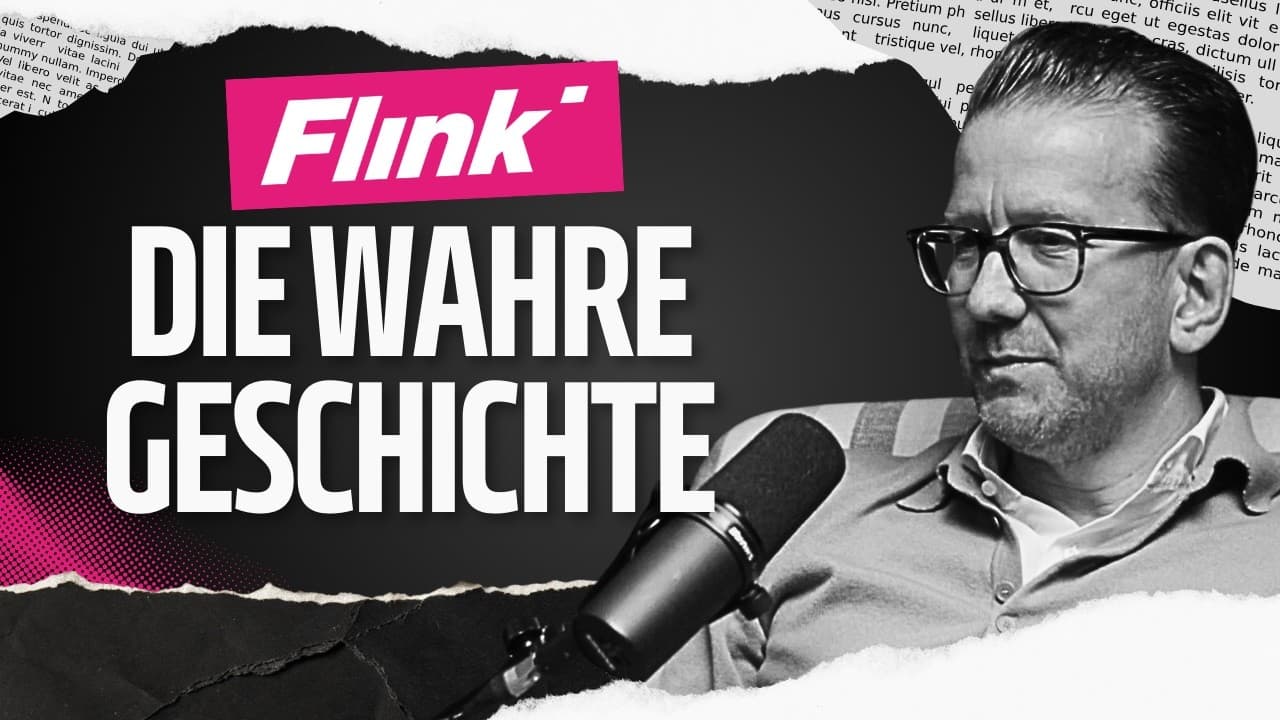
Oliver Merkel grew up in Leipzig, studied in Berlin and St. Gallen and spent around 20 years as a consultant at BCG and Bain, most recently leading Bain's consumer and retail practice in Africa. He was once a formal co-founder and early backer of Flaconi. In November 2020, in the middle of Covid, he founded Flink, the grocery delivery service built on many small hubs instead of one central warehouse, turned down a billion-dollar takeover offer from GoPuff six months later and raised close to a billion for Flink in total. In February 2025 the supervisory board did not renew his contract; he remains the largest private shareholder. Today he is building Blocks with co-founder Andreas Schröter, a company that guarantees startups a 20 percent cut in their cloud bill. He still invests in startups, has four kids and plays tennis.
Episodes
Numbers from the episode
FAQ
Why did Flink turn down GoPuff's billion-dollar offer?
GoPuff's term sheet in summer 2021 was worth one billion, but mostly in shares of a company that was itself valued at 10 billion and burning more than 100 million a month. Oliver Merkel says that for a billion in cash they would have sold immediately. Instead Flink kept the offer alive as an option and closed a Series B that valued the company at two billion dollars after seven months. To the episode →
How big is Flink today?
The numbers are not public, but according to Oliver Merkel the reported 650 to 700 million in revenue last year is probably not far off. Flink runs around 150 hubs in Germany and the Netherlands, is cash-flow positive and profitable and keeps growing at double-digit rates. In total Flink has raised close to a billion; Oliver still holds a little less than 10 percent. To the episode →
What was Flink's Banana Gate?
Flink sold bananas individually at a fixed price because the hubs had no scales. In the home-made, Google-Sheets-based ordering system, the stock keeping unit (one banana) got mixed up with the handling unit (an 18-kilo box), and suddenly thousands of extra bananas arrived in the hubs. Flink turned it into a promotion and sold the bananas at a discount. According to Oliver it was neither a growth hack nor an app bug, just a manual error in the early days. To the episode →
Why did Oliver Merkel have to leave as Flink's CEO?
In February 2025 the supervisory board decided not to renew the contracts of Oliver Merkel and his co-founder. Oliver points to differing views on direction: after reaching profitability he wanted to grow more aggressively and invest more, the board did not. He accepted the decision in the company's interest, remains the largest private shareholder and a customer, and still talks to the investors. To the episode →
What does Blocks do?
Blocks is Oliver Merkel's new company and works like a membership club for cloud costs. After a short audit, Blocks guarantees 20 percent savings on existing AWS spend. The three levers: group buying along the lines of the Edeka cooperative, automated savings plans where Blocks takes on the commitment risk, and the AI agent Major Tom, which scans the infrastructure and reports unused resources, cost anomalies and security gaps via Slack. Blocks only earns a share of the savings, there is no contract term, and the company is meant to never exceed 50 employees. To the episode →
Why does Oliver Merkel write memos instead of PowerPoint?
For Oliver a memo forces you to formulate your thinking clearly in full sentences, while PowerPoint delegates responsibility to the meeting. At Flink and Blocks investors got no deck, only a three- to four-page memo he polished for around two weeks. His rules: no adjectives, hard numbers in prose rather than tables, short sentences, no acronyms, and any reader without prior knowledge has to understand it. He uses whiteboards early on to structure thinking and memos to prepare big decisions. To the episode →
Quotes
„Ich habe mal gelernt in meinem Leben, if people throw money at you, you take it.““One thing I've learned in life: if people throw money at you, you take it.”
„Es war die beste unbezahlte Kampagne.““It was the best unpaid campaign we ever had.”
„Also ich glaube, das Learning ist immer, wenn Secondaries möglich sind, sollte man auch Geld vom Tisch nehmen.““I think the lesson is always: when secondaries are possible, you should take money off the table.”
„Hätte ich mir das anders gewünscht? Ja, hätte ich, aber manchmal ist es halt so, dann muss man es halt akzeptieren.““Would I have wished for a different outcome? Yes, I would. But sometimes that's just how it is, and then you have to accept it.”
„Wenn du einen PowerPoint sendest, das ist Delegieren von Verantwortung.““Sending a PowerPoint is delegating responsibility.”