

Who this is

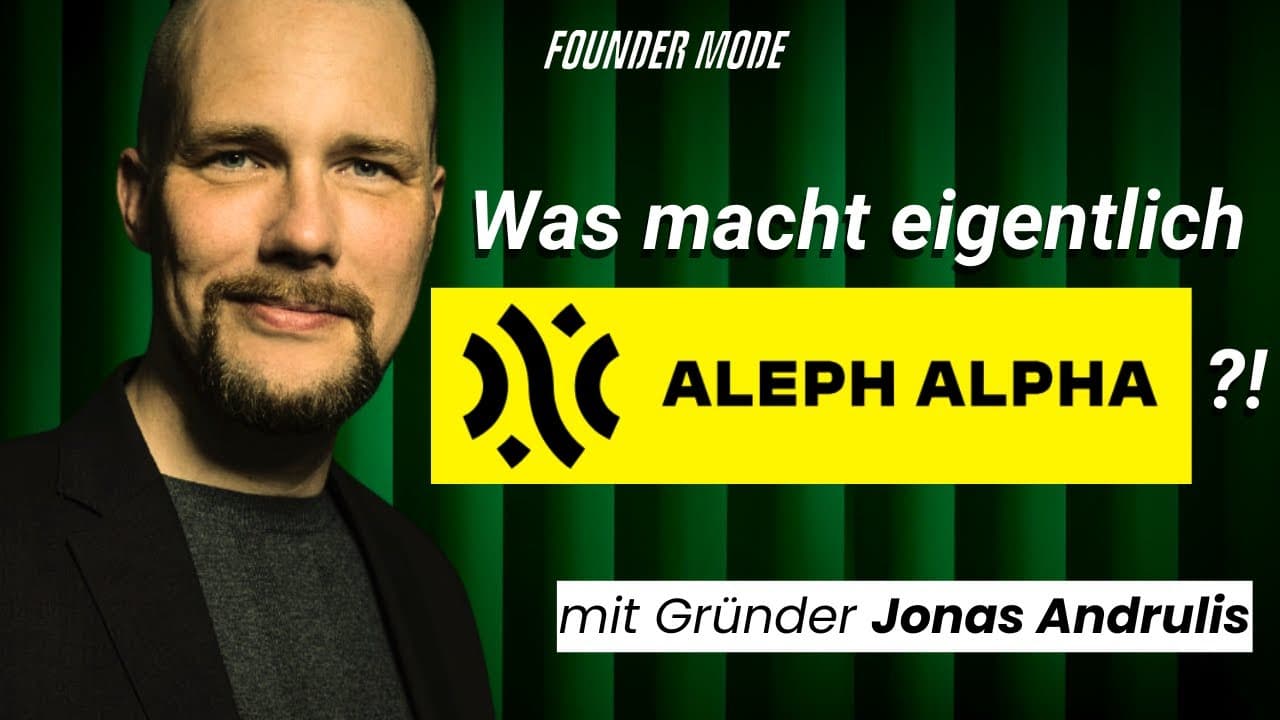
Jonas Andrulis studied industrial engineering at KIT, wrote his thesis at SAP Research and led a strategic impact modeling team at Deloitte. In 2013 he started Pallas Ludens, a company that had gamers in more than 200 free-to-play games label computer vision training data, with AI deciding which images were worth labeling. He then spent about three years in a senior AI research role in Apple's Special Projects Group. In 2019 he founded Aleph Alpha in Heidelberg together with Samuel, whom he knew from school and from Deloitte. In this episode he speaks as founder and CEO of Aleph Alpha.
Episodes
Numbers from the episode
FAQ
What does Aleph Alpha do?
According to Jonas Andrulis, Aleph Alpha builds AI as a sovereign foundation for the transformation of companies, governments and security agencies. Its software full stack covers human-machine collaboration, evaluation, LLMs and ready-made applications and can also run air-gapped on the customer's own hardware. Unlike the hyperscalers' black-box offerings, it is meant to make clear how a result came about. To the episode →
Who are Aleph Alpha's customers?
Large companies and governments, meaning public administration and security agencies, including defence and intelligence services. The close collaboration with Germany's Federal Employment Agency is public. There are also industrial partners from the cap table such as Schwarz Gruppe, SAP, Bosch, Deutsche Bank and Burda, plus other industrial customers of a similar size. To the episode →
Is Aleph Alpha the German ChatGPT?
No. Jonas calls this one of the big misunderstandings. Consumer applications were never the focus; from the start Aleph Alpha wanted to help where sensitive data and high responsibility are involved. The company deliberately stayed out of the race for the biggest LLM and the most GPUs. To the episode →
What did Jonas Andrulis do at Apple?
After Pallas Ludens, Jonas spent about three years at Apple in a senior AI research role in the Special Projects Group. He compares it to Q Branch in James Bond: the projects were so secret that he couldn't tell most colleagues what he was working on. He left because corporate politics became too much for him. To the episode →
Where does the name Aleph Alpha come from?
From set theory. Aleph-null is the smallest infinite set, that of the countable numbers. Aleph Alpha stands for a larger infinity. For Jonas it's an image for generalising AI that can solve an infinite number of problems, including ones nobody anticipated during training. To the episode →
Which business idea would Jonas like young founders to build?
AI mentoring for children and teenagers. Whether someone has a supportive family makes a huge difference. AI could support kids from difficult backgrounds or who aren't native speakers where teachers and youth services don't have the time. Anyone who wants to build it should reach out to Jonas, who might even invest. To the episode →
Quotes
„Also, Souveränität bedeutet bei uns auch Wahlfreiheit für Silicon.““For us, sovereignty also means freedom of choice in silicon.”
„Unser Game ist Innovation. Unser Game ist Wertschöpfung und Souveränität bei unseren Kunden herstellen und darauf arbeiten wir hin.““Our game is innovation. Our game is creating value and sovereignty for our customers, and that's what we're working towards.”
„Du willst scheitern, du willst daraus lernen und dann machst du die nächste Sache und die machst du zehnmal besser.““You want to fail, you want to learn from it, and then you do the next thing and you do it ten times better.”
„Was mich wirklich ärgert, ist, dass wir durch diesen ganzen AI-Act haben wir über Jahre hinweg die gesamte kreative Energie unseres AI-Leaderships von Innovation auf Compliance gelenkt.““What really annoys me is that with this whole AI Act we spent years steering the entire creative energy of our AI leadership away from innovation and towards compliance.”
„Wir haben genug Arbeitsgruppen gemacht. Wir haben genug auf Panels gesessen. Jetzt müssen wir umsetzen.““We've had enough working groups. We've sat on enough panels. Now we have to execute.”